


Discover why real human AI avatars outperform CGI for trust and engagement. Compare authenticity, use cases, and results with data-backed insights.
Why the most realistic AI videos use real people, not computer-generated faces
You're scrolling through your feed when you see an AI-generated video. Within seconds, something feels… off. The lighting is too perfect. The smile is too smooth. The eyes don't quite match the emotion. You can't put your finger on it, but you know it's not real.
That's the uncanny valley effect—and it's costing brands trust, engagement, and conversions.
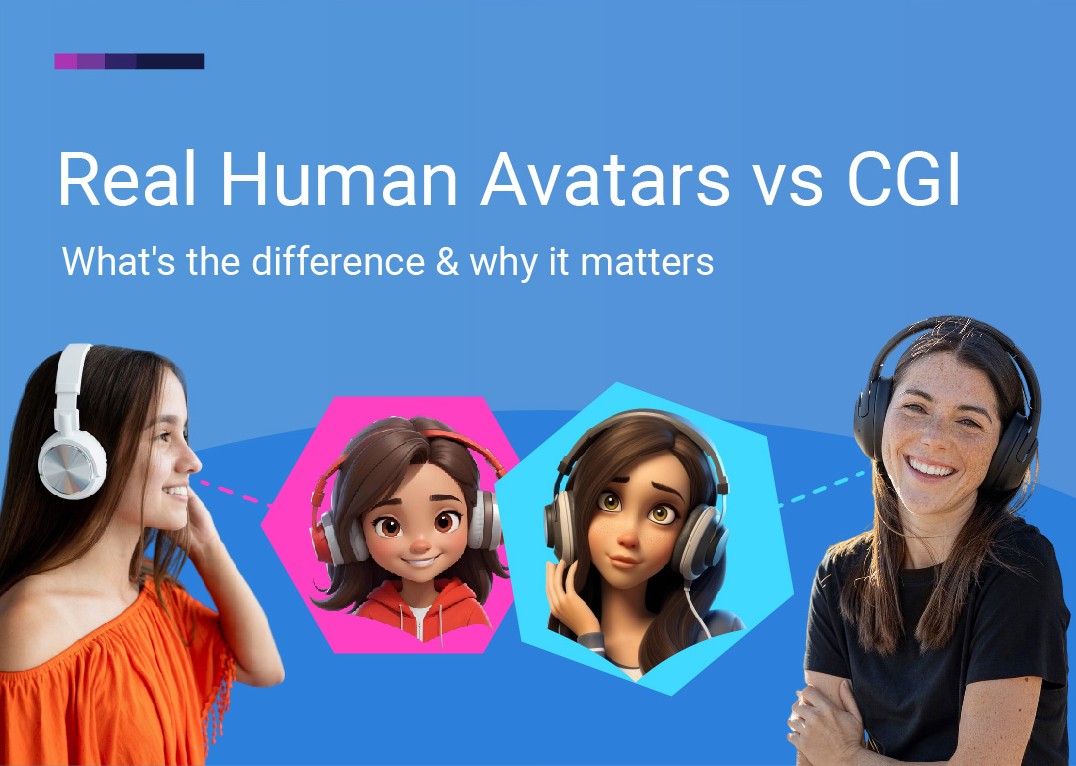
As AI avatar technology explodes in 2025, there's a critical divide forming: CGI avatars (computer-generated faces built from scratch) vs real human avatars (actual people filmed and digitized for AI video generation).
The market is booming—the global AI video market is projected to grow from $3.86 billion in 2024 to over $17 billion by 2030 (Grand View Research, 2024). But as adoption accelerates, the question isn't just if you'll use AI video—it's which type of avatar will build the trust your audience demands.
The difference isn't just technical—it's psychological. And if you're creating content for marketing, education, or customer communication, understanding this gap could be the difference between a video that converts and one that gets scrolled past.
In this guide, we'll break down:
What makes an avatar "real" vs "synthetic"
Why authenticity matters more than perfection
When to use each type (and when NOT to)
Real data on trust and engagement
How to choose the right avatar platform for your goals
See Real Human Avatars in Action
CGI avatars (also called synthetic avatars or digital humans) are created entirely by computers. Think of them as 3D models brought to life through:
Generative Adversarial Networks (GANs)
3D facial modeling software
Motion capture or AI-driven animation
Examples: Many popular AI video platforms use this approach—faces that never existed, designed to look 'perfect.'
The Appeal:
Full creative control (design any face, any feature)
No consent/IP issues (it's not a real person)
Consistent lighting and quality
The Trade-Off:
Often triggers uncanny valley response
Can feel sterile, overly polished, or 'too perfect'
Lacks the micro-expressions and imperfections that signal authenticity
May not build trust in high-stakes contexts (testimonials, medical, financial)
Real human AI avatars start with actual people—filmed on location, in natural environments, with real expressions and body language. The AI doesn't create the face; it learns to animate the person's existing footage based on new scripts.
How It Works:
Real people are filmed (with consent and IP agreements)
AI maps their facial movements, speech patterns, and expressions
Users type a script, and the AI generates new videos using that person's likeness
The result: videos that feel human because they ARE human
Examples: LipSynthesis's hundreds of stock avatars—teachers, professionals, everyday people filmed in offices, cafes, parks, and homes.
The Appeal:
Authentic facial expressions and micro-movements
Natural environments and lighting
Builds trust immediately (viewers recognize 'real')
Diverse, relatable representation
No uncanny valley effect
The Trade-Off:
Limited to existing filmed people (can't design from scratch)
Requires consent and IP management
Quality depends on filming conditions"
Create Your Own Custom Avatar from Your Video
Here's the counterintuitive truth: imperfection builds trust.
Studies on the uncanny valley effect show that as digital faces approach—but don't quite reach—human realism, they trigger discomfort and distrust. CGI avatars often fall into this gap.
The Data:
88% of consumers say authenticity is important when deciding which brands they like and support (Stackla, 2019)
Videos featuring authentic, relatable content consistently outperform polished, studio-produced content in engagement metrics (HubSpot, 2024)
Research on the uncanny valley effect shows that near-human digital faces trigger discomfort and distrust in viewers (MacDorman, Green, Ho, & Koch, 2009)
Why Real Human Avatars Win:
Micro-expressions: Tiny, involuntary facial movements signal genuine emotion
Environmental context: Real backgrounds (not green screens) add credibility
Imperfect lighting: Natural shadows and highlights feel authentic
Relatable diversity: Real people represent real audiences
Think about it: Would you trust a customer testimonial more from a glossy CGI face or from someone who looks like they could be your neighbor?
Use Case | Best Choice | Why |
|---|---|---|
Customer testimonials | Real Human Avatars | Trust is critical; viewers need to believe the person is real |
Product demos | Real Human Avatars | Relatability drives conversions |
UGC-style ads | Real Human Avatars | Authenticity is the whole point of UGC |
Personalized outreach | Real Human Avatars | Recipients can tell if it's "too perfect" |
Educational content | Real Human Avatars | Students engage better with relatable instructors |
Fantasy/sci-fi branding | CGI Avatars | When you WANT it to feel futuristic or otherworldly |
High-concept creative | CGI Avatars | Artistic projects where realism isn't the goal |
Mascots or characters | CGI Avatars | Brand characters don't need to feel "real" |
The Bottom Line:
If your goal is trust, relatability, or conversion, real human avatars win. If your goal is creative fantasy or brand character, CGI can work.
When evaluating AI avatar platforms, ask:
1. Are the avatars real people or CGI?
Look for phrases like 'filmed on location,' 'real human avatars,' or 'consent-based'
Red flags: 'synthetic faces,' 'generated avatars,' overly glossy promo videos
2. Can you create unlimited videos?
Some platforms charge per video or per minute
LipSynthesis offers unlimited generation on the Pro Plan
3. Can you create a custom avatar?
Your own face = maximum personalization
Check turnaround time (LipSynthesis: 5-6 hours)
4. What's the learning curve?
Best platforms: pick avatar → type script → generate
Avoid: complex editing software or technical setup
5. How diverse is the avatar library?
Look for age, ethnicity, profession, setting variety
LipSynthesis: 300+ avatars across demographics and environments"
Browse Hundreds of Real Human Avatars
Scenario 1: E-commerce Brand Testing Product Review Videos
Challenge: Need 50 variations of product testimonials to test hooks, avatars, and scripts
Solution: Used LipSynthesis real human avatars to create 50 videos in 2 days
Result: Found winning combination with 4.2% CTR (vs 1.8% with stock footage)
Scenario 2: SaaS Startup Personalizing Outreach
Challenge: Cold outreach videos felt robotic and got ignored
Solution: Created custom avatar of founder, personalized scripts per prospect
Result: 23% reply rate (vs 5% with generic video)
Scenario 3: Online Course Creator Scaling Content
Challenge: Filming new lessons was time-consuming and expensive
Solution: Created custom avatar, generated 100+ lesson videos from scripts
Result: Course launched 3 months faster, students rated instructor as 'relatable'
Visual: Screenshots or GIFs of avatar examples
As AI avatar technology matures, we're seeing explosive growth and a clear market split. The global AI video market is projected to grow from $3.86 billion in 2024 to over $17 billion by 2030 (Grand View Research, 2024)—and businesses are already seeing results: 78.8% report reduced production time, with employees saving an average of 45 hours per month (Synthesia, 2025).
But the market is splitting into two distinct tracks:
Track 1: Hyper-Realistic CGI
Pushing toward indistinguishable from reality (think Hollywood VFX budgets). Expensive, niche, high-concept.
Track 2: Authentic Human Digitization
Scaling real people for accessible, trustworthy content creation. This is where LipSynthesis lives—and where the mass market is headed.
Why? Because most businesses don't need a $100K digital human. They need:
Affordable, unlimited video creation
Avatars that build trust
Zero learning curve
Fast iteration for testing
The future isn't about replacing humans with CGI. It's about empowering real humans to scale their presence through AI.
In the battle between real human AI avatars and CGI avatars, there's no universal winner—but there IS a clear choice for most use cases.
If you're building trust, driving conversions, or creating relatable content, real human avatars are your best bet. They carry the authenticity, micro-expressions, and psychological cues that CGI can't replicate (yet).
CGI has its place in creative, fantasy, or character-driven projects. But for marketing, education, testimonials, and outreach? Real wins.
Ready to see the difference?
Explore LipSynthesis's library of hundreds of real human avatars—filmed on location, diverse, and ready to bring your scripts to life. Or create your own custom avatar in hours.
Because the best AI videos don't just look real. They ARE real.
Start Creating with Real Human Avatars → Sign up now
See How Custom Avatars Work → Custom AI avatars guide
By the LipSynthesis Team
We're on a mission to make video creation accessible to everyone—using real people, not CGI. Our platform features hundreds of eal human avatars filmed on location, plus custom avatar creation so you can scale your own presence through AI.
Explore our platform at lipsynthesis.com or read more insights on our blog.