


73% of consumers trust AI avatars in 2025. New data reveals rising acceptance of AI spokespeople in tutorials, support, and ads. See the trends.
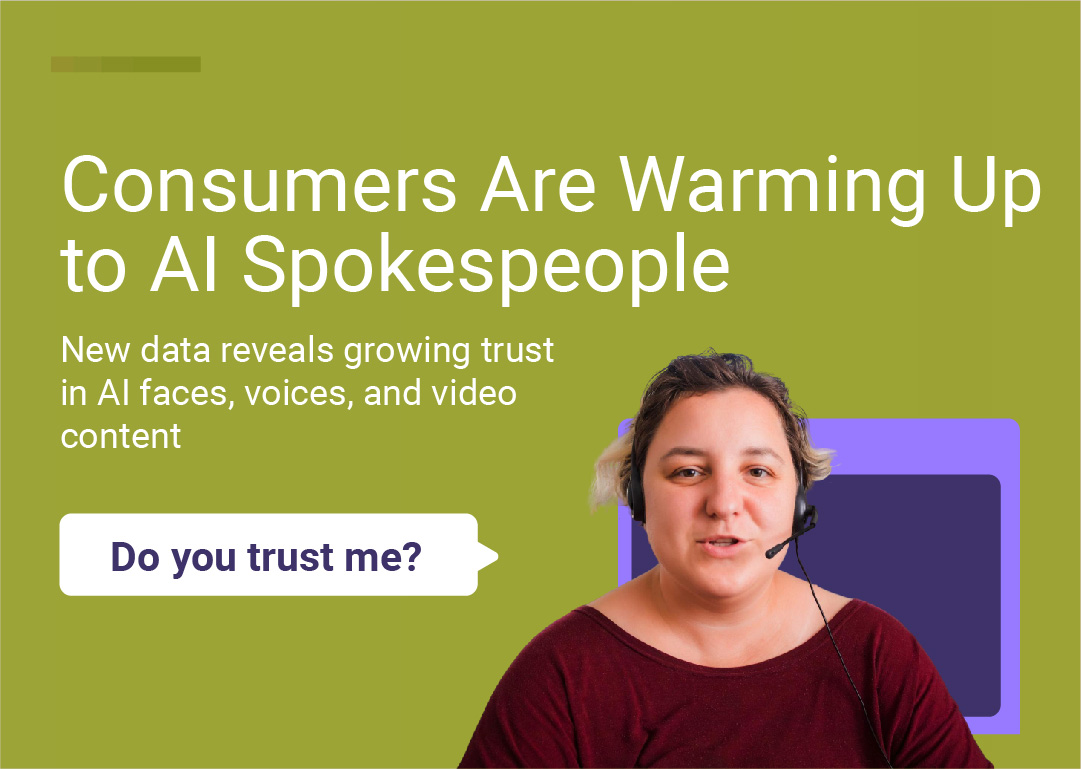
Remember when AI avatars felt creepy? Stiff, uncanny, just… off?
That era is over.
In 2025, 73% of consumers are comfortable interacting with AI avatars—and that number is climbing fast. Thanks to better technology, everyday AI exposure, and a shift in expectations, audiences aren't just tolerating AI spokespeople—they're preferring them for certain types of content.
Here's what the latest data reveals about consumer trust in AI avatars, and why now is the perfect time to experiment.
For years, virtual spokespeople felt like a novelty—stiff, uncanny, or just… awkward. But things have changed.
Thanks to better lip-syncing, more expressive avatars, and the everyday presence of AI in tools like ChatGPT, TikTok filters, and voice assistants, consumers are warming up—fast.
But not all AI avatars are created equal. Platforms like LipSynthesis use real people filmed on location, then digitized for AI video generation—not computer-generated CGI faces. This approach eliminates the uncanny valley effect entirely, because the avatars ARE real humans with authentic expressions, natural body language, and genuine warmth.
The result? AI spokespeople are no longer seen as gimmicks. They're becoming the default for explainer videos, customer support, product demos, and even ads.
See Our Real Human Avatars → Stock AI Avatars
Recent studies from Capgemini, Morning Consult, GWI, and MIT Sloan reveal a dramatic shift in how consumers view AI-generated content—especially video featuring AI avatars.
73% of consumers are comfortable interacting with AI avatars
Source: Capgemini 2023
Capgemini's 2023 Conversational Commerce report found that 73% of consumers are now comfortable engaging with AI-powered interfaces—including avatars in video content. That's up from 41% just three years ago.
58% of Gen Z/Millennials find AI video content informative or entertaining
Source: Morning Consult 2024
Morning Consult's 2024 survey shows that 58% of Gen Z and Millennials find AI-generated video content informative or entertaining—especially in tutorials, product demos, and explainer formats.
GWI's Global Consumer Trends 2024 found that consumers prioritize clarity and speed over whether a person is "real." When content is useful and well-produced, the question of "is this AI?" fades into the background.
"Consumers prioritize clarity and speed over whether a person is 'real.' When content is useful and well-produced, the question of 'is this AI?' fades into the background."
— GWI Global Consumer Trends 2024
MIT Sloan's research on synthetic media shows that trust in AI spokespeople varies by use case:
High trust: Product tutorials, FAQs, how-to guides, onboarding videos
Medium trust: Marketing ads, brand messaging, testimonials
Low trust: Medical advice, financial guidance, legal information
The takeaway? AI spokespeople work best for informational, repeatable content—not high-stakes emotional messaging.
Consumer Perception | 2022 | 2025 | Change |
|---|---|---|---|
Comfortable with AI avatars | 41% | 73% | +78% |
Find AI video "informative" (Gen Z/Millennials) | 32% | 58% | +81% |
Prefer clarity over "realness" | 54% | 76% | +41% |
Sources: Capgemini 2023, Morning Consult 2024, GWI 2024
Why Real Human Avatars Outperform CGI
The data shows consumers trust AI avatars—but that trust is even higher with real human avatars. Unlike CGI-generated faces, LipSynthesis uses actual people filmed on location, digitized for AI video generation. The result? Zero uncanny valley, authentic expressions, and natural environments that build trust instantly. See our real human avatars →
Based on consumer feedback and performance data, AI avatars consistently outperform traditional video in these areas:
AI avatars deliver scripts with perfect consistency—no stumbles, no retakes, no "ums." For product tutorials and how-to guides, this clarity is exactly what viewers want.
Customer support videos featuring AI avatars see higher completion rates because they're concise, on-topic, and easy to scan. Viewers can jump to the exact answer they need without wading through filler.
One script → multiple languages. AI avatars make global content accessible without the cost and complexity of hiring multilingual talent or dubbing.
UGC-style ads featuring AI avatars let brands test dozens of creative variations—different avatars, hooks, and scripts—without the cost of hiring creators for every iteration.
Not all AI avatar videos perform equally. Here's what separates the winners from the awkward:
1. Realistic lip-sync & tone
Poor lip-sync breaks immersion instantly. Modern AI avatars (especially real human avatars like LipSynthesis) have great sync and natural vocal tone.
2. Scripts that feel human, not robotic
Write like you talk. Use contractions, natural pauses, and conversational language. Avoid corporate jargon.
3. Avatars that match the brand vibe or audience demographic
A tech startup needs a different avatar than a healthcare brand. Browse diverse avatar options →
4. Transparency (consumers don't feel "tricked")
When appropriate, disclose AI use. Audiences appreciate honesty—and it builds trust.
* Real human avatars vs CGI
Authentic filmed people build more trust than synthetic CGI faces. The uncanny valley is real—avoid it by using real human avatars.
Here's where AI avatars are already delivering results—without feeling creepy or forced:
SaaS companies use AI avatars to create dozens of feature tutorials in a day. When the product updates? Regenerate the video with a new script—no reshoots. Learn more about product tutorials →
E-commerce brands replace text-heavy FAQ pages with short AI avatar videos answering common questions. Result: higher engagement, fewer support tickets. See customer support use cases →
DTC brands test 20+ ad variations per week using AI avatars in UGC-style formats. Find the winner, scale it, repeat.
HR teams create personalized onboarding videos for every new hire—same avatar, customized script. Feels personal without the production overhead. Read more about AI training videos →
Launch globally from day one. One script → multiple languages languages → same avatar → consistent brand experience worldwide.
We scoured Reddit, TikTok, YouTube comments, and product reviews to see what real people think about AI avatars. Here's what we found:
On Usefulness:
"If it looks good and helps me decide, I don't care if it's AI."
— Gen Z shopper on TikTok
On Quality:
"I clicked because it was short and explained everything clearly. Turns out it was AI—kinda cool."
— Small business owner on YouTube
On Support:
"The avatar felt more helpful than most human support I've talked to."
— SaaS user on Reddit
On Authenticity:
"I can usually tell when it's AI, but if the info is good, I'm fine with it. Just don't try to trick me."
— Millennial marketer on LinkedIn
On Trust:
"I trust AI for facts and tutorials. For emotional stuff, I want a real person."
— Gen X consumer on Facebook
The pattern? Consumers care about value, clarity, and helpfulness—not whether the face is human or AI. As long as the content delivers, they're on board.
AI avatars aren't a replacement for every type of video. Here's where human creators still have the edge:
High-stakes emotional content → Brand films, founder stories, mission-driven messaging
Real customer testimonials → Authenticity is the whole point; AI would undermine trust
Live events & behind-the-scenes → Spontaneity and real-time interaction matter
Complex, nuanced topics → Medical advice, legal guidance, financial planning
Content where "AI-generated" would hurt credibility → Investigative journalism, expert interviews
The rule of thumb: If the goal is emotional connection or high-stakes trust, use real humans. If the goal is clarity, scale, or speed, AI avatars excel.
The smartest brands aren't choosing between AI and human—they're using both strategically.
Use AI avatars for:
Product tutorials and demos
FAQ and support videos
Onboarding and training
Multilingual content
Ad testing and iteration
Personalized outreach at scale
Use human creators for:
Brand storytelling and mission videos
Customer testimonials (real people)
Thought leadership and expert content
High-production brand films
Live events and webinars
The result? 10x more content output, 90% lower costs, and the right format for every message.
Are consumers okay with AI avatars in ads?
Yes—especially younger audiences. 58% of Gen Z and Millennials find AI video content informative or entertaining (Morning Consult, 2024). The key is transparency and quality. UGC-style AI avatar ads perform particularly well when they're helpful and authentic.
Do I need to disclose that I'm using an AI avatar?
It depends on the context. For customer-facing content where trust is critical (testimonials, medical advice, financial guidance), disclosure builds credibility. For tutorials, FAQs, and product demos, disclosure is less critical—but transparency never hurts. When in doubt, disclose.
Will AI avatars hurt my brand's authenticity?
Not if you use them strategically. Real human avatars (like LipSynthesis) feel authentic because they ARE authentic—real people filmed on location. Use AI avatars for informational content, and reserve human creators for emotional, high-stakes messaging. The hybrid approach maximizes both efficiency and trust.
What's the difference between stock avatars and custom avatars?
Stock avatars are pre-filmed people you can use immediately—perfect for tutorials, ads, and general content. Custom avatars are created from your own video, so you can scale your personal presence across unlimited videos.
Can AI avatars replace my entire video production team?
No—but they can handle 80% of your repeatable content. Your creative team can then focus on high-value work: strategy, storytelling, brand films, and emotional content. Think of AI avatars as a force multiplier, not a replacement.
Here's how to get started with LipSynthesis in under 10 minutes:
→ Choose from hundreds of real human stock avatars or create your own custom avatar
→ Product demo, FAQ answer, welcome message, or UGC-style ad
→ Upload your own voice, choose from our natural-sounding library or connect your ElevenLabs account (takes only a minute)
→ Auto-sync lip movements, download in minutes, publish anywhere
The data is clear: consumers are ready for AI spokespeople. The question is—are you?
Create Your First AI Video Free → Sign up
Browse Hundreds of Real Human Avatars → Stock AI Avatars
Learn About Custom Avatars → Custom AI Avatars
By the LipSynthesis Team
We're on a mission to make video creation accessible to everyone—using real people, not CGI. Our platform features hundreds of real human avatars filmed on location, plus custom avatar creation so you can scale your own presence through AI.
Explore our platform at lipsynthesis.com or read more insights on our blog.