


AI avatars will dominate 80% of business video by 2026. Discover why brands are switching, backed by Gartner data and real ROI examples. See the future of video content.
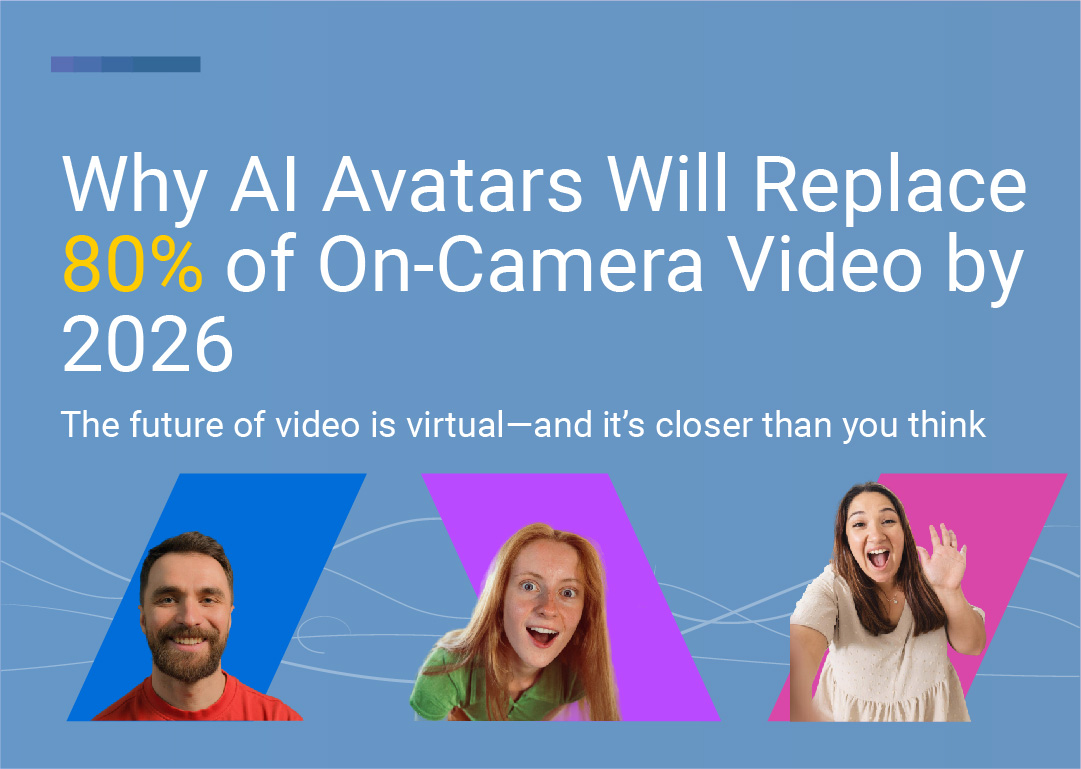
Your video production pipeline is about to get 10x faster—and 90% cheaper. Here's why 80% of business video will be AI-generated by 2026, and what that means for your team, your budget, and your competitive edge.
If you're a marketer, trainer, or product lead, you know the drill: you're not producing less content—you're being asked for MORE. More videos, faster turnarounds, more languages, more platforms. And traditional video production? It just can't keep up.
Enter AI avatars: digital versions of real people that can deliver your scripts on demand, in any language, without a camera crew, studio time, or reshoot costs.
This isn't speculative. By 2026, analysts predict that 80% of business video content will be AI-generated—and the shift is already happening. Companies are cutting production time by 80%, slashing costs by 90%, and scaling content in ways that were impossible just two years ago.
In this post, we'll break down:
Why AI avatars are gaining ground so fast
The data behind the 80% prediction
Real-world use cases already delivering ROI
What this means for your content strategy by 2026
How to get started (even if you've never used AI video tools)
See Real Human AI Avatars in Action
The demand for video isn't slowing down. By 2022, video accounted for 82% of all internet traffic (Cisco). Brands need more content, faster—but traditional video production is expensive, slow, and difficult to scale.
AI avatars solve all three problems.
Three forces are converging to make AI avatars the default choice for most business video:
1. Video demand is exploding
87% of marketers say video has directly increased sales, and 91% want even more video content from brands (Wix, 2024). But traditional production can't keep pace with this demand.
2. AI avatar quality has crossed the trust threshold
The uncanny valley is fading—especially with real human AI avatars. Unlike CGI-generated faces, platforms like LipSynthesis use actual people filmed on location, then digitized for AI video generation. The result? Avatars that feel authentic because they ARE authentic—real expressions, natural environments, and genuine human warmth.
73% of consumers are now comfortable buying from brands that use AI-generated video (Wyzowl, 2024)—a massive shift from just two years ago.
3. The ROI is undeniable
Companies using AI avatars report:
80% reduction in production time
90% lower costs compared to traditional video
10x more content output with the same team
50+ languages from a single script
When Synthesia analyzed their enterprise customers, they found an average savings of $50,000 per year in video production costs alone.
The LipSynthesis Difference
Unlike CGI-generated avatars that can feel sterile or "too perfect," LipSynthesis uses real people filmed on location—teachers, professionals, everyday humans with authentic expressions and natural body language. No uncanny valley. Just trust-building, relatable content at AI speed. Explore our real human avatars
So where does the "80% by 2026" figure come from? It's not a single study—it's a convergence of industry trends, adoption rates, and analyst predictions.
2023: 12% of businesses regularly used AI video tools (SiegeMedia)
2024: 31% adoption (nearly 3x growth in one year)
2025 (projected): 55-60% adoption
2026 (projected): 75-85% adoption
Gartner predicts that by 2026, synthetic media (including AI avatars) will account for the majority of enterprise video content—particularly in training, support, and internal communications.
Cost pressure:
Traditional video production costs $1,000-$10,000 per finished minute. AI avatar videos? $0-$50.
Speed requirements:
Marketing teams need to test 10+ variations of ad creative. Traditional production: weeks. AI avatars: hours.
Multilingual expansion:
Translating and re-filming video content costs $5,000-$20,000 per language. AI avatars handle 50+ languages from one script.
Content volume demands:
Marketers who use video grow revenue 49% faster than those who don't (HubSpot). But you can't scale traditional video fast enough to meet demand.
By 2026, here's what the 80% will likely include:
Video Type | AI Avatar Adoption |
|---|---|
Employee training & onboarding | 90-95% |
Product tutorials & demos | 85-90% |
Customer support & FAQ videos | 80-85% |
Internal communications | 75-80% |
Social media ads (UGC-style) | 70-75% |
Personalized outreach | 65-70% |
Brand storytelling & emotional content | 10-20% |
The 20% that stays human? High-stakes, emotional content where authenticity is paramount—brand films, executive messaging, testimonials from actual customers (not avatars).
This isn't theoretical. Companies across industries are already using AI avatars to replace traditional video—and seeing measurable results.
The Old Way:
Film training videos once, hope they don't need updates. When they do? Start from scratch.
The AI Avatar Way:
Create a custom AI avatar of your trainer. Update content by typing new scripts—no reshoots, no scheduling, no studio time.
Real Impact:
"We reduced onboarding video production time by 80%—without losing a single point of engagement. Our new hires actually prefer the AI avatar format because they can rewatch lessons at their own pace."
— Enterprise customer using LipSynthesis
The Challenge:
Software updates every month. Video tutorials are outdated before they're published.
The Solution:
Use AI avatars to create evergreen tutorial templates. When features change, update the script in minutes.
Example:
A SaaS company creates 50 tutorial videos per quarter using real human AI avatars from LipSynthesis's stock library. Pro Plan. Traditional production estimate: $25,000/quarter.
The Old Way:
Hire voice actors for each language. Re-film or dub. Budget: $5,000-$20,000 per language.
The AI Avatar Way:
One script → 20+ languages automatically. Same avatar, same visual consistency.
Real Numbers:
A global e-learning platform expanded from 3 languages to 12 languages in one month using AI avatars—something that would have taken 18 months and $150,000+ with traditional production.
The Opportunity:
Personalized email videos have an 8x higher click-through rate than standard email campaigns (Campaign Monitor).
The Problem:
Recording individual videos doesn't scale.
The AI Solution:
Create a custom avatar of yourself, then generate personalized messages for each prospect. Same authentic face, unlimited scale.
Use Cases:
Sales outreach
Customer success check-ins
Event invitations
Renewal reminders
The Insight:
User-generated content (UGC) style ads outperform polished brand content by 23% (HubSpot A/B tests).
The Challenge:
Hiring UGC creators for every test is expensive and slow.
The AI Advantage:
Use LipSynthesis's diverse library of hundreds of real human avatars—filmed in authentic environments like homes, offices, and cafes—to create UGC-style content at scale.
Testing Strategy:
Create 20 variations (different avatars, hooks, scripts) in one day. Find your winner. Scale it.
Here's what the video landscape will likely look like in 2026:
Video production is democratized
You don't need a production team or $50K budget. Anyone with a script can create professional video content.
Content testing becomes standard
Instead of producing one "perfect" video, teams create 10-50 variations and let data decide the winner.
Multilingual becomes default
Global reach isn't a luxury—it's built into every video from day one.
Personalization scales
Every customer, prospect, or employee can receive personalized video messages without manual recording.
Commodity video work disappears
Basic talking-head videos, product demos, and training content shift to AI.
High-value creative work grows
Storytelling, strategy, emotional content, and brand films still need human creators.
New roles emerge
"AI video strategists," "avatar content directors," and "synthetic media managers" become standard positions.
More helpful content
Brands can afford to create comprehensive tutorials, FAQs, and support videos—content that was too expensive before.
Content in your language
No more settling for auto-translated captions. Native-quality video in 50+languages.
Need for transparency
As AI video becomes ubiquitous, clear labeling ("This video uses AI avatar technology") becomes standard practice.
Ready to join the 80%? Here's your step-by-step roadmap:
Start with the video type that's:
Time-consuming to produce traditionally
Needs frequent updates
Requires multiple variations for testing
Best starter use cases:
Stock avatars (like LipSynthesis's hundreds of real human library):
Start immediately
Diverse demographics and settings
Perfect for tutorials, ads, and general content
Real people filmed on location (not CGI)
Custom avatars (your own face):
Maximum personalization
Brand consistency (same "host" across all content)
Ideal for thought leadership and personal outreach
Pro tips:
Write how you speak (conversational, not formal)
Keep sentences short (easier for AI lip-sync)
Include natural pauses ("Let's talk about... [pause] ...the three key benefits")
Test one version first, then iterate
With LipSynthesis's unlimited Pro Plan, you can:
Create as many videos as you need
Test different avatars, hooks, and scripts
Iterate until you find what works
Scale your winners
No video editing experience required. Pick avatar → type script → generate. That's it.
Track the metrics that matter:
Engagement: Watch time, completion rate
Conversion: Click-through rate, sign-ups, sales
Efficiency: Time saved, cost per video
Once you find your winning formula, scale it across:
More use cases
More languages
More platforms
More personalization
Factor | Traditional Video | AI Avatar Video |
|---|---|---|
Cost per video | $5,000-$50,000 | $0-$50 |
Production time | 2-6 weeks | a few minutes-6 hours |
Updates/changes | Reshoot = start over | Update script instantly |
Multilingual | $5,000-$20,000 per language | multiple languages included |
Iterations | 1-3 versions (budget limited) | Unlimited variations |
Personalization | Not scalable | Fully scalable |
Quality | High (if budget allows) | Professional & authentic |
Best for | Emotional, high-stakes content | Scalable, repeatable content |
Will AI avatars replace human video creators?
No. AI avatars are best for scalable, repeatable content like training videos, product demos, and tutorials. High-stakes emotional content still needs real human creators. Think of it as AI handling the informational 80%, while humans focus on the creative 20%.
How much can businesses save with AI avatar videos?
Companies typically report 80% reduction in production time and 90% lower costs compared to traditional video. Enterprise customers save an average of $50,000+ per year (Synthesia case studies). A traditional tutorial costs $1,000-$10,000 to produce; with AI avatars, you can create hundreds of these for a fraction of the cost.
Are AI-generated videos effective for marketing?
Yes. 73% of consumers are comfortable buying from brands using AI video (Wyzowl, 2024), and AI avatar content sees 23% higher completion rates than text-based content (HubSpot). The key is authenticity—real human avatars (not CGI) build trust and drive engagement.
What types of videos work best with AI avatars?
AI avatars excel at informational, scalable content: product tutorials, training videos, customer support FAQs, multilingual content, UGC-style ads, and personalized outreach. They're perfect when you need consistent quality across hundreds of videos or frequent updates without reshoots.
How long does it take to create an AI avatar video?
With stock avatars, you can create your first video in minutes depending on the length. Custom avatars take around 5-6 hours (but it could vary depending on the server load and video quality) to process, then generate videos in minutes depending on the length. Compare that to traditional video: 3-6 weeks from concept to final cut.
Do AI avatars look fake or robotic?
It depends on the platform. CGI avatars can trigger the "uncanny valley" effect. Real human avatars (like LipSynthesis's filmed-on-location avatars) use actual people with natural expressions and authentic environments—no uncanny valley. 73% of consumers can't tell the difference from traditional video.
What's the ROI of switching to AI avatar videos?
Most companies see ROI within the first month. Typical results: 95% reduction in production time, 10-100x more content output, and $20,000-$50,000 saved per quarter. One mid-size SaaS company created 120 videos (vs. 4 previously) and increased product adoption by 34% in their first quarter.
The shift to AI-generated video isn't coming—it's already here. The question isn't if you'll use AI avatars, but when you'll start.
By 2026, 80% of business video will be AI-generated. Companies that adopt early will have a massive competitive advantage: faster content, lower costs, better testing, and global reach.
Here's how to begin today:
Pick your most time-consuming video type:
Training or onboarding videos
Product demos or tutorials
Customer support content
Social media ad testing
Option A: Use LipSynthesis's real human stock avatars → start immediately
Option B: Create your own custom avatar → ready in 5-6 hours
Try it free → 1 minute of AI video generation, no credit card required.
Track the metrics that matter:
Production time saved
Cost per video
Engagement rates (watch time, completion)
Conversion impact (clicks, sign-ups, sales)
Once you find your winning formula:
Create unlimited variations with LipSynthesis Pro Plan
Expand to multiple languages
Test different avatars, hooks, and scripts
Scale across all your video use cases
The future of video isn't about replacing humans—it's about empowering them to create more, faster, and better than ever before.
Start Creating AI Avatar Videos Free → Sign up
See Real Human Avatars in Action → Stock AI Avatars
Learn How Custom Avatars Work → Custom AI Avatars
By the LipSynthesis Team
We're on a mission to make video creation accessible to everyone—using real people, not CGI. Our platform features hundreds of real human avatars filmed on location, plus custom avatar creation so you can scale your own presence through AI.
Explore our platform at lipsynthesis.com or read more insights on our blog.