


Generate high-performing AI UGC variations in 2026. Test hooks, avatars, proof, and CTAs one variable at a time—plus a simple variation matrix.
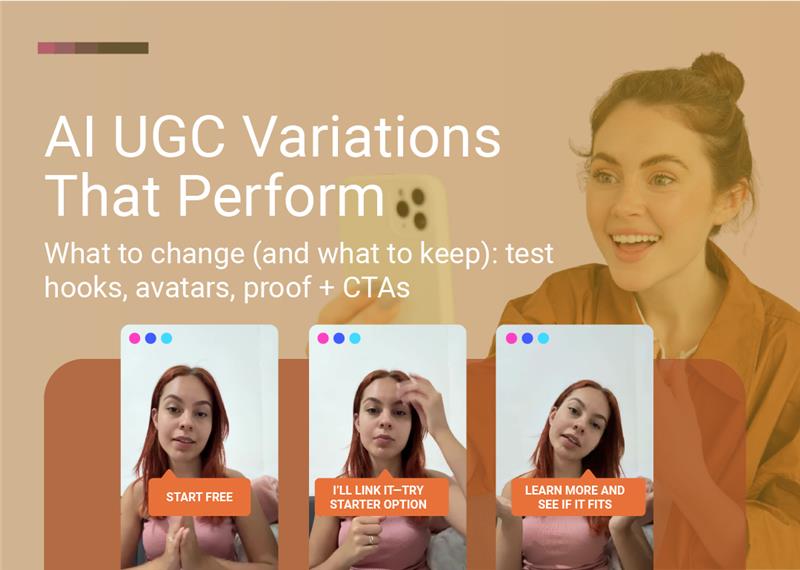
Creating more AI UGC ads isn’t hard in 2026. Creating better ones is.
Most teams “make variations” by changing everything at once—new hook, new avatar, new CTA, new tone—then wonder why results are inconsistent.
This guide gives you a simple, repeatable system to generate AI UGC variations that still feel authentic. You’ll learn what to keep constant, what to change, and how to test hooks, avatars, proof, and CTAs without turning your ads into obvious “generated” content.
If you want clean learnings, you need a control.
Keep these constant for a full testing round:
Offer (price, trial, guarantee)
Core promise (the main benefit)
Video length (roughly)
Format (selfie-style, captions on, vertical)
One primary channel (TikTok vs Reels vs Facebook)
Then change one variable per round.
Hooks decide whether anyone watches long enough to hear your proof.
Hook types that consistently create strong variations:
Specific result: “I got result in time—and I didn’t expect it.”
Objection-first: “I thought this was too expensive / a scam / not for me…”
Pattern interrupt: “Stop doing common behavior if you want outcome.”
Curiosity: “Nobody told me this about category…”
Persona callout: “If you’re a persona, you need to hear this.”
A hook can be great and still fail if the avatar doesn’t match the script.
What “match” means in practice:
Energy fits the claim (calm for trust, upbeat for promos)
Age/vibe fits the persona you’re calling out
Visual setting feels plausible for the story
AI UGC fails when it’s all claims and no texture.
Proof types to rotate:
Timeline: “By day 7, specific change.”
Number: “metric went from before to after.”
Specific detail: a feature, moment, or constraint that sounds real
Mini demo: one quick step or screen moment
Your CTA should match intent and channel.
CTA variations to test:
“Start with free trial.”
“I’ll link it—try starter option.”
“If you’re comparing options, check this first.”
“Learn more and see if it fits.”
Use this simple flow so you learn quickly without creating noise.
Round | Keep constant | Change | Goal |
|---|---|---|---|
1 | Same avatar, same proof, same CTA | 3–5 hooks | Find the winning angle |
2 | Best hook, same proof, same CTA | 2–3 avatars | Find the best persona match |
3 | Best hook + avatar, same CTA | 2 proof types | Make it more believable |
4 | Best combo | 2 CTAs | Improve click + conversion |
Use this when you want to isolate messaging.
Generate 3–5 versions where only the first line changes.
Version 1: specific result hook
Version 2: objection-first hook
Version 3: pattern interrupt hook
Version 4: curiosity hook
Version 5: persona callout hook
Tip: keep the body nearly identical so you can attribute performance to the hook.
Use this when the message is working, but the delivery feels off.
Generate 2–3 versions:
Avatar 1: calm, trustworthy, “explainer” energy
Avatar 2: more casual, creator vibe
Avatar 3: more authoritative, professional vibe
Tip: don’t change the script—only change the avatar and delivery.
Use this when watch time is okay but conversions are weak.
Generate 2 versions:
Proof version 1: timeline + specific detail
Proof version 2: mini demo moment
Tip: add one concrete detail per version. Even a small constraint can help (time, situation, comparison).
Use this when you’re repurposing a winner across platforms.
TikTok: more casual, slightly imperfect pacing
Instagram Reels: a touch cleaner, still conversational
Facebook: clarity-first, slower, proof earlier
Use this checklist before you publish:
Does it sound like a person—not a landing page?
Is there at least one specific detail (time, number, situation, sensory detail)?
Is the pacing natural (not robotic-fast, not overly dramatic)?
Do captions match the spoken words (and appear quickly)?
Is the first frame interesting enough to stop the scroll?
If you want more help making AI UGC feel natural, start with our full guide on AI UGC Ads.
Track these in order:
Thumbstop rate (first 2 seconds)
Watch time / completion rate
CTR
CPA / ROAS (for paid)
Only scale a variation after it wins on watch time and click.
Changing multiple variables at once: use the matrix and isolate one change.
Wrong persona match: swap avatars before rewriting the whole script.
No proof: add one timeline, number, or demo moment.
Over-produced delivery: keep it channel-native and slightly imperfect.
With LipSynthesis, you can turn scripts (or real customer reviews) into short-form videos that feel personal and relatable—using real human avatars filmed on location, not CGI.
Start Creating with Real Human Avatars → Sign up now
See How Custom Avatars Work → Custom AI avatars guide
By the LipSynthesis Team
We're on a mission to make video creation accessible to everyone—using real people, not CGI. Our platform features hundreds of eal human avatars filmed on location, plus custom avatar creation so you can scale your own presence through AI.
Explore our platform at lipsynthesis.com or read more insights on our blog.